
MUSC&141 Creative Music Fundamentals
The Keyboard, Grand Staff and ASPN
Chelsey Hamm and Melanie Sehman
Key Takeaways
- A pattern of black keys grouped into twos and threes repeats on the piano keyboard for seven octaves.
- The white note C is to the immediate left of the two-note black key pattern, while the white note F is to the immediate left of the three-note black key pattern.
- Pianists read music on the grand staff.
- Middle C is the note that appears on the line between the two staves in a grand staff.
- American Standard Pitch Notation (ASPN) provides labels for specific musical frequencies by combining a note name (such as C) with a subscript octave designation (such as 4).
- ASPN differentiates between octaves, from C to B. The octaves are labeled from lowest to highest, beginning with 0 and continuing in ascending numerical order (1, 2, etc.).
Many students find studying music theory easier when they engage with music kinesthetically. In other words, physically creating sounds by playing a musical instrument (such as the piano) helps you to better visualize and audiate the music you are writing down or studying. This allows students to understand and “feel” the relationship between different pitches more quickly.
The Piano Keyboard
Learning to play notes on the piano is one easy way to engage with music kinesthetically. You may find access to a piano keyboard (acoustic or electronic) at your school. You may also purchase an inexpensive electronic keyboard if you like. Another option is to download a free piano app that you can play on your phone, such as Tiny Piano.
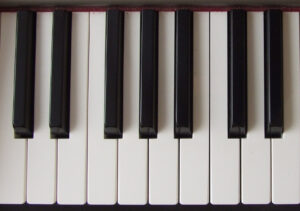
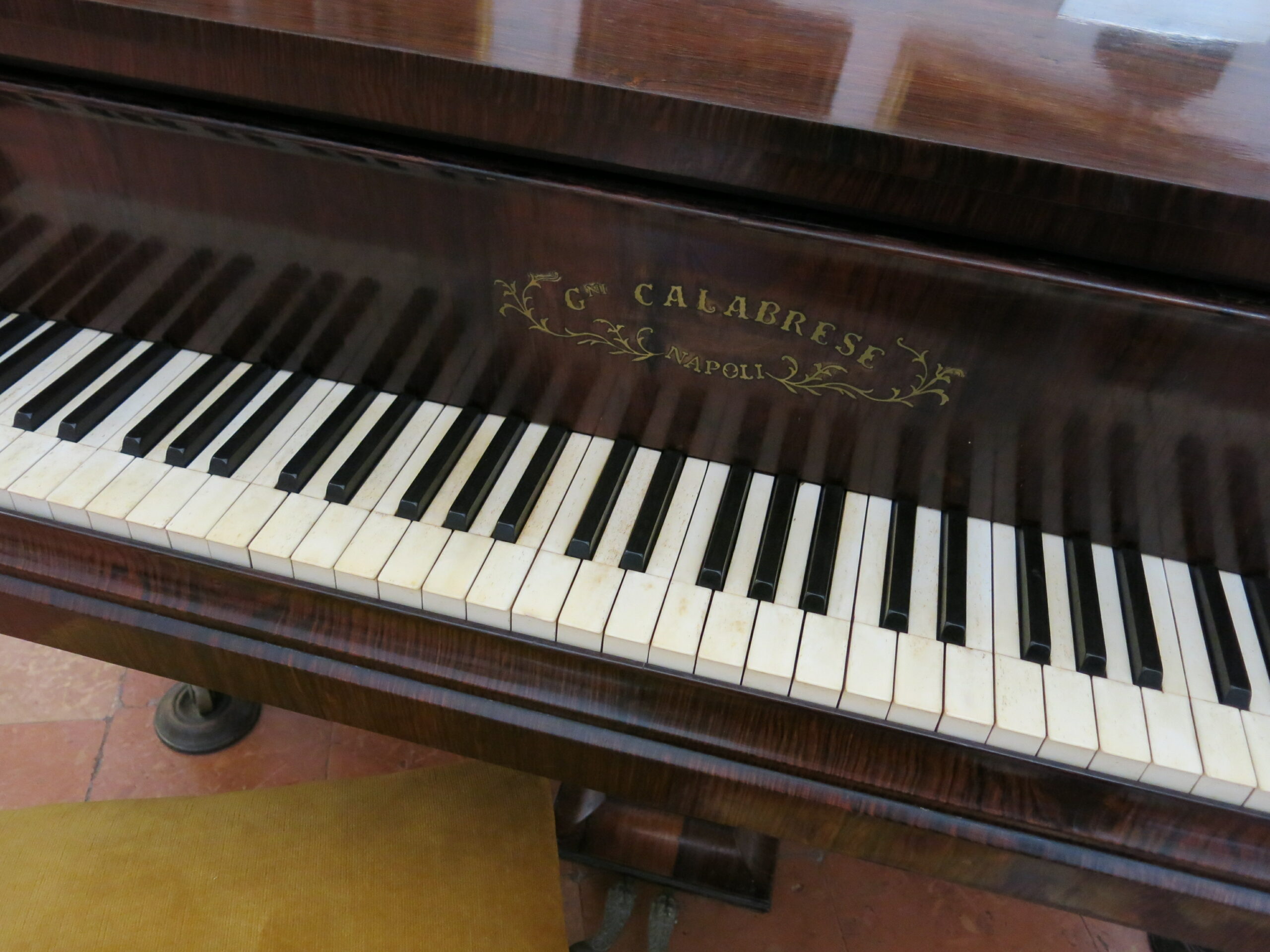
In Example 1, notice that the keyboard has both white keys and black keys. The black keys are grouped into sets of either three or two. In Example 2, notice that the sets of three and two black keys alternate throughout the entire length of a piano keyboard, repeating the pattern for each octave.
Octave Equivalence and White Key Letter Names on the Piano Keyboard
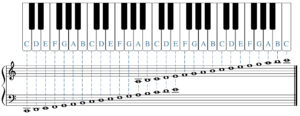
Example 4 shows a piano keyboard with the letter names of the white key pitches labeled. The same letter names appear on different keys of the keyboard. As discussed in the previous chapter, pitches in Western musical notation are designated by the letters A, B, C, D, E, F, and G, repeating in a loop. Because of the principle of octave equivalence in the Western system, pitches separated by an octave have the same letter name.

On the piano keyboard, when the black keys appear as a set of two, the note to their immediate left is C. With a set of three black keys, the note to their immediate left is F.
You can practice identifying the white key notes on the piano keyboard in the following exercise:
The Grand Staff
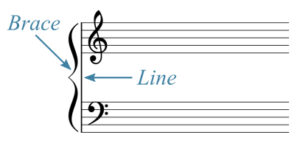
Music for the piano is typically written in both the treble and bass clefs on a grand staff, as shown in Example 5. To make a grand staff, a staff with a treble clef is placed above a staff with a bass clef. The two staves are connected on the left side with a line and a brace. Typically, the pianist plays the lower notes (in the bass clef) with their left hand and the higher notes (in the treble clef) with their right hand.
Example 6 shows the lines and spaces on the grand staff labeled with letter names. As you can see, the letter names of the lines and spaces of the treble and bass clefs match what was discussed in the prior chapter (Reading Clefs).
Let’s take a closer look at the ledger-line notes that might appear below the treble staff and above the bass clef staff. Example 7 shows some of these notes, labeled with letter names. Each vertical pair of notes is the same pitch, even though the notes are notated in two different clefs. (The notes with upward-pointing stems belong to the treble clef staff, while the notes with downward-pointing stems belong to the bass clef staff.)
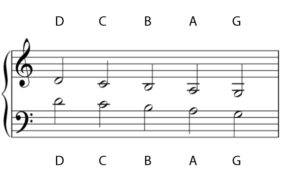
Example 8 shows the staves of Example 7 vertically condensed—how these notes would appear if there were not so much space in between the treble clef and bass clef staves of a grand staff. The letter names are the same in Example 8 as they were in Example 7.

Example 8. The staves of Example 7 have been vertically condensed and the two notes combined into one (with two stems).
Example 9 shows a vertically condensed grand staff with a box around the note C. This boxed C is called middle C, so named because in the vertically condensed grand staff shown in Example 9, it appears in the middle of the treble and bass clef staves. Additionally, middle C is the note that appears to be around the middle of a piano keyboard, usually underneath the brand name.
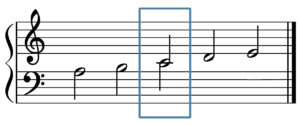
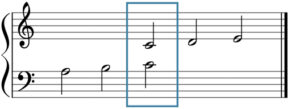
Example 10 shows Example 9 vertically expanded to its regular spacing, with middle C still boxed. Though it now appears in both the treble clef and bass clef staves, this note would still sound as the same pitch.
American Standard Pitch Notation and Pitch versus Pitch Class
In order to discuss specific notes, or pitches, we will use American Standard Pitch Notation, abbreviated ASPN. ASPN designates specific musical pitches by combining a note name (such as C) with a subscript octave designation (such as 4), for example, C4. ASPN labels are very useful, since they can identify every possible musical note on a piano keyboard, from the lowest pitches to the highest.
Music theorists distinguish between a pitch, a discrete tone with an individual frequency (e.g. C4 using ASPN), versus a pitch class, which includes all the pitches with the same letter name, in any octave, along with their enharmonic equivalents (e.g., C in general). For example, all Cs are the same pitch class.
ASPN and Octave Designations
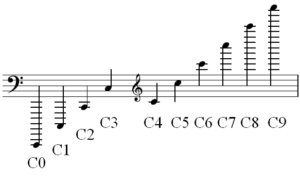
ASPN differentiates between octaves, beginning with the pitch C and ending with the pitch B.You may wonder why octaves numbers change with the pitch C instead of A (the beginning of the alphabet). This means that each new octave designation begins on the note C, as seen in Example 1. The octaves are labeled from lowest to highest, beginning with 0 and continuing in numerical order (1, 2, 3, etc.). The pitch middle C is C4, which is useful to memorize.
All letter names within an octave (below the C of the next octave) receive the same octave designation. For example, all of the notes in Example 2 would be designated in the 4 octave, because they are above C4 but below C5. Accidentals applied to a note do not have an effect on its ASPN number. For example, B♯3 and C4 have different octave numbers despite being enharmonically equivalent, because the B♯ is still considered part of the lower octave.

You can practice ASPN notation in all clefs in the following exercise:
ASPN and the Keyboard
ASPN labels are very helpful for finding specific notes on the piano keyboard. Example 3 depicts a piano keyboard with each octave labeled using ASPN notation. As you can see, the piano keyboard spans the full octaves 1 to 7. It also contains a small part of both octaves 0 and 8. ASPN labels are the same regardless of instrument or voice type. In other words, a C4 will always be labeled as such regardless of whether it is produced with a flute, trombone, violin, or voice.

Media Attributions
- Piano Keyboard © Wikimedia Commons is licensed under a CC BY-SA (Attribution ShareAlike) license
- Keyboard White Keys © Sarah Louden is licensed under a CC BY-SA (Attribution ShareAlike) license
- Grand Staff Brace Line © Sarah Louden is licensed under a CC BY-SA (Attribution ShareAlike) license
- Grand Staff Notes Labelled © Sarah Louden is licensed under a CC BY-SA (Attribution ShareAlike) license
- Ledger Lines Grand Staff Same Notes 2 © Chelsey Hamm is licensed under a CC BY-SA (Attribution ShareAlike) license
- Ledger Lines Below Staff Same Notes 2 © Chelsey Hamm is licensed under a CC BY-SA (Attribution ShareAlike) license
- Middle C Staff Close Together © Sarah Louden is licensed under a CC BY-SA (Attribution ShareAlike) license
- Vertically Expanded Grand Staff C Boxed © Sarah Louden is licensed under a CC BY-SA (Attribution ShareAlike) license
- Octave Designations © Wikimedia Commons is licensed under a Public Domain license
- Octave 4 ASPN Labels © Chelsey Hamm is licensed under a CC BY-SA (Attribution ShareAlike) license
- Piano ASPN Labels © AlwaysAngry adapted by Megan Lavengood is licensed under a Public Domain license
Two staves placed one above the other, connected by a brace. The top staff has a treble clef, while the bottom staff has a bass clef.
C₄; the C near the middle of the piano keyboard, written on the first ledger line below the treble clef staff or the first ledger line above the bass clef staff.
Designates specific musical frequencies by combining a note name (such as C) with an octave designation (such as 4), creating a bipartite label (C₄).
An interval of twelve half steps between two notes with the same letter name. The frequencies of two notes related by octave form a 2:1 ratio. Abbreviated “8ve.”
Relating to movement of parts of the body.
To imagine hearing a sound in one's mind.
A relationship between pitches that share a letter name but are separated by one or more octaves.
A discrete tone with an individual frequency.
A group of pitches that are octave equivalent and enharmonically equivalent.