
MUSC&141 Creative Music Fundamentals
Swing Rhythms
Megan Lavengood
Key Takeaways
- Swing eighths are notated as regular straight eighths but performed unevenly, in a quasi-triplet rhythm where the first note is twice as long as the second.
- Backbeat, a syncopation created through accent on beats 2 and 4 of a quadruple meter, is common in jazz.
- Syncopation occurs when the hierarchy of the meter is obscured.
Jazz has many characteristic uses of rhythm that define it as a genre. This chapter introduces two especially signficant rhythms—swing eighths and the backbeat—and discusses syncopation generally.
The Basic Swing Groove
Swing eighths
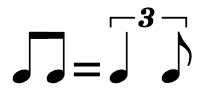
One of the most recognizable features of swing rhythms is swung eighth notes. Swing eighths are performed as uneven eighth notes in a quasi-triplet rhythm, shifting the proportion from 1:1 to, roughly, 2:1—that is, the first eighth note is about twice as long as the second eighth note. This is illustrated with notation in Example 1.
While in some sense it may be more accurate to notate the eighth notes of a jazz tune as a triplet rhythm as notated in Example 1, imagine how cluttered that would be! Instead, swing eighth notes in jazz are always written as straight eighth notes, and performers are expected to know to swing them.
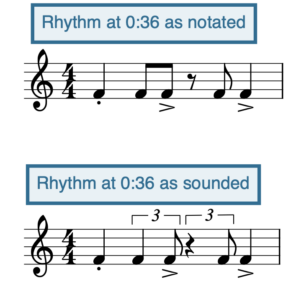
The overture from the musical Anything Goes contains passages with both straight and swing eighths. The first few minutes are swung; this is easiest to hear at 0:36 when all the instruments in the ensemble play swing eighths together (Example 2).While listening, tap along to the swing eighths—and note that the tempo is very brisk, so you’ll be tapping quite quickly.
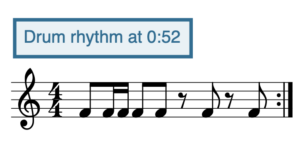
Contrast this with the straight eighths in the middle section of the overture, which begins at 0:52 (Example 3). The feel changes dramatically during this straight section. As you listen, tap along to the straight eighths, which are at a considerably slower tempo than the first part’s swing eighths.
After a quick transition in the trumpets, swing eighths return for the third part of the overture, which begins at 1:39. The swing eighths are audible in the hi-hat cymbal of the drumset.
The triplet rhythm notated in Example 1 is a common way to explain swing, but in reality, the exact ratio of swing eighths varies from piece to piece and from performer to performer. Generally speaking, faster tempos tend to be more straight and slower tempos tend to employ a more dramatic swing. Compare the swing of “Eternal Triangle” by Dizzy Gillespie and “Duet” by Count Basie—the former has a more even swing rhythm, while the latter has a more uneven swing.
Backbeat
The next most significant rhythmic feature of jazz is the backbeat. The backbeat is an accent on beats 2 and 4 of a quadruple meter. This is the opposite of the typical accent structure of classical music, where beats 1 and 3 are usually the most accented. (Beat 1 is still important in jazz, though—that’s still usually where chord changes occur and roots of chords are sounded. It just may not be the loudest beat.) The backbeat and the swing eighth together make up an important part of a standard swing drum beat (Example 4). The backbeat is accented with the closed hi-hat cymbal, while the swing eighths are played on the ride cymbal. Drum beats vary widely and are typically improvised, but these are two components you will find in most jazz drum patterns.
When tapping along with jazz tunes, try tapping along to the backbeat, rather than the downbeat.
Media Attributions
- Anything Goes 1 © Megan Lavengood is licensed under a CC BY-SA (Attribution ShareAlike) license
- Anything Goes 2 © Megan Lavengood is licensed under a CC BY-SA (Attribution ShareAlike) license
A performance practice in which two notated eighth notes are performed unequally, in about a 2:1 proportion.
Eighth notes that are equal, as opposed to swing eighths (which are unequal).
An accent on beats 2 and 4 of a quadruple meter. Backbeats are common in jazz and pop styles.