
MUSC&141 Creative Music Fundamentals
Compound Meters
Mark Gotham; Chelsey Hamm; and Melanie Sehman
Key Takeaways
- Compound meters are meters in which the beat divides into three and then further subdivides into six.
- Duple meters have groupings of two beats, triple meters have groupings of three beats, and quadruple meters have groupings of four beats. You can determine these groupings aurally by listening carefully and tapping along to the beat.
- There are different conducting patterns for duple, triple, and quadruple meters; these are the same in both compound and simple meters.
- Time signatures in compound meters express two things: how many divisions are contained in each measure (the top number), and the division unit—which note gets the division (the bottom number).
- Rhythms in compound meters get different counts based upon their division unit. Beats that are not articulated (because they contain more than one beat or because of ties, rests, or dots) receive parentheses around their counts.
In the previous chapter, Simple Meters, we explored rhythm and meter signatures in simple meters—meters in which the beat divides into two and further subdivides into four. In this chapter, we will learn about compound meters—meters in which the beat divides into three and further subdivides into six.
Listening to and Conducting Compound Meters
Compound meters can be duple, triple, or quadruple, just like simple meters. The difference is that, in compound meters each beat unit divides into groups of three instead of two, as you can hear by listening carefully to the following examples:
-
“Godzilla” (2017) by Kesha is in a compoundduple meter—the strong beats recur every two pulses, but each of those two pulses divide into groups of three instead of two. If you further subdivide the beat (by tapping twice as fast), you will feel that the beat subdivides into six parts.
- The second movement (Minuet) of Franz Joseph Haydn’s Sonata no. 42 in G Major (1784) is in a compound triple meter. Listen for the groupings of three beats, each of which divides into three.
- Finally, a compound quadruple meter contains four beats, each of which divides into three. Listen to “Exogenesis Symphony Part III” (2010) by the alternative rock band Muse. This is in a compound quadruple meter; in other words, the beats are grouped into a four pattern.
Review the conducting patterns for duple, triple and quadruple meters in the previous chapter, as they are the same for simple and compound meters.
Compound Meter Signatures
Measures in compound meters are organized into groups of two, three and four pulses (duple, triple, or quadruple), just as they are in simple meters. However, the two numbers in the meter signature express different information for compound meters. The top number of a meter signature in compound meter expresses the number of beats in a measure, while the bottom number expresses the note value representing the beat division. Example 1 shows a common compound-meter time signature.
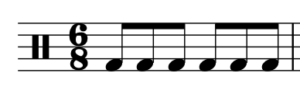
Just like in simple meter, compound-meter time signatures are not fractions (and there is no line between the two numbers), and they are placed after the clef on the staff. In Example 1, the top number (6) means that each measure will contain six beats; the bottom number (8) means that the eighth note is the beat division. This means that each measure in this time signature will contain six eighth notes, as you can verify by examining Example 1.
In compound meters, the top number is always a multiple of three. Divide this number by three to find the corresponding number of beats in simple meter: top numbers of 6, 9, and 12 correspond to duple, triple, and quadruple meters respectively. In compound meters, the bottom number is usually one of the following:
- 8, which means the eighth note represents the beat division.
- 4, which means the quarter note represents the beat division.
- 16, which means the sixteenth note represents the beat division.
The following table summarizes the six categories of meters that we have covered so far:
[table id=36 /]
Example 2. Categories of meters.
You can practice compound meter time signatures in the following exercise:
Counting in Compound Meter
While counting compound meter rhythms, it is recommended that you conduct in order to keep a steady tempo. Because beats in compound meter divide into three, they are always dotted. Beats in compound meter are as follows:
- If 8 is the bottom number, the beat is a dotted quarter note (equivalent to three eighth notes).
- If 4 is the bottom number, the beat is a dotted half note (equivalent to three quarter notes).
- If 16 is the bottom number, the beat is a dotted eighth note (equivalent to three sixteenth notes).
In simple meters, the beat divides into two parts, the first accented and the second non-accented. In compound meters, the beat divides into three parts, the first accented and the second and third non-accented. The counts for compound meter are different from simple meter, as demonstrated in Example 3, which is in  .
https://musescore.com/user/32728834/scores/8394558/embed
Example 3. Counting in a compound duple meter.
In this time signature, each measure has two beats (6÷3=2), indicating duple meter. Each dotted quarter note (the beat) gets a count, which is expressed in Arabic numerals, like in simple meter. For notes that are longer than one beat (such as the dotted half note in the fourth measure of Example 3), the beats that are not counted out loud are still written in parentheses. Divisions are counted using the syllables “la” (first division) and “li” (second division). As the final measure of Example 3 shows, further subdivisions at the sixteenth-note level are counted as “ta,” with the “la” and “li” syllables on the eighth-note subdivisions remaining consistent.
The third measure of Example 3 presents two of the most common compound-meter rhythms with divisions, so make sure to review this measure carefully if you are not familiar with compound meter.
Please note that your instructor may employ a different counting system. Open Music Theory privileges American traditional counting, but this is not the only method.
Example 4 gives examples of rhythms in (a) duple, (b) triple, and (c) quadruple meter. Just as with simple meters, compound duple meters have only two beats, compound triple meters have three beats, and compound quadruple meters have four beats.
https://musescore.com/user/32728834/scores/8394447/embed
Example 4. (a) Compound duple has two beats, (b) compound triple has three beats, and (c) compound quadruple has four beats.
Like in simple meters, beats that are not articulated because of rests and ties are written in parentheses and not counted out loud, as shown in Example 5. However, dotted rhythms do not cause beats to be written in parenthesis the way they do in simple meter, because in compound meter dotted notes receive the beat.
https://musescore.com/user/32728834/scores/6296091/embed
Example 5. Beats that are not counted out loud are put in parentheses.
You can practice note/rest equivalencies in both simple and compound meter time signatures in the following exercise:
Counting with Division Units of Quarter- and Sixteenth-Notes
So far, we have focused on meters with a dotted-quarter beat. In compound meters with other beat units (shown in the bottom number of the time signature), the same counting patterns are used for the beats and subdivisions, but they correspond to different note values (Example 6).
https://musescore.com/user/32728834/scores/8394456/embed
Example 6. The same rhythm written with three different beat units: (a) dotted quarter, (b) dotted half, and (c) dotted eighth.
Each of these rhythms sounds the same and is counted the same. They are also all considered compound triple meters. The difference in each example is the bottom number—which note gets the division unit (eighth, quarter, or sixteenth), which then determines the beat unit.
Beaming Rhythms in Compound Meter
In compound meters, beams still connect notes to reflect the meter type: duple, triple or quadruple. In the first measure of Example 7, sixteenth notes are grouped into sets of six, because six sixteenth notes in a meter signature are equivalent to one beat. In the second measure of Example 7, sixteenth notes are grouped into sets of three, because three sixteenth notes in a  meter signature are equivalent to one beat.
https://musescore.com/user/32728834/scores/8394474/embed
Example 7. Beaming in two different meters.
When the music involves note values smaller than a quarter note, beams clarify the meter, regardless of whether the meter signature is simple or compound. Example 8 shows twelve sixteenth notes beamed properly in two different meters. The first measure is in simple meter, so the notes are grouped by beat into sets of four; in the second measure, the compound meter requires the notes to be grouped by beat into sets of six.

The same rules of stemming and flagging that applied in simple meter still apply in compound meter. For notes above the middle line, stems point downward on the left side of the note, and for notes below the middle line, stems point upward on the right side of the note. Stems on notes on the middle line can point in either direction, depending on the surrounding notes. Flags always go to the right of the stem.
Like in simple meters, partial beams can be used for mixed rhythmic groupings. If you aren’t yet familiar with these conventions, pay special attention to how the notes in Example 9 are beamed.
https://musescore.com/user/32728834/scores/6296096/embed
Example 9. The most common partially beamed variations with a division unit of the eighth note.
Media Attributions
- Compound Meter Time Signature © Chelsey Hamm is licensed under a CC BY-SA (Attribution ShareAlike) license
A meter that divides the beat into three parts.
A meter with two beats per measure.
A meter with three beats per measure.
A meter with four beats per measure.
An indication of meter in Western music notation, often made up of two numbers stacked vertically. Also known as meter signature.
The note value that divides the beat into two or three parts (in simple or compound meters, respectively); for example, the eighth note in 4/4 or 6/8. See also beat division.
A meter that divides the beat into two parts.
Created by bar lines, a measure (or bar) is equivalent to one beat grouping.
The horizontal lines that connect certain groups of notes together.