MUSC&141 Creative Music Fundamentals
Introduction to Western Musical Notation and Reading Pitches
Chelsey Hamm and Melanie Sehman
Key Takeaways
- The term “Western musical notation” refers to written symbols that are used to communicate musical sounds.
- Western musical notation is one of many different systems of musical notation that appear across time spans, places, and cultures.
- Pitch in Western musical notation is designated by the letters A, B, C, D, E, F, and G, which repeat in a loop.
- Different clefs make reading different ranges easier.
- Each clef indicates how the lines and spaces of the staff correspond to pitch.
Music is an auditory or aural art form that can be represented visually with notation.
Think about what it’s like to translate one language to another. It can be a challenging task—a direct word-for-word translation isn’t always possible or useful, so a translator needs to think about how best to communicate to the reader. Similarly, writing down sounds involves making decisions about what needs to be communicated and how. No system of notation could capture every aspect of sound in full detail and still be useful or readable, so only some musical elements can be depicted.
Despite this, there are several advantages to written musical notation. For example, a written musical work does not need to be memorized, and details can be recorded that might otherwise be forgotten. Additionally, written notation makes musical works accessible to more people, since anyone who knows the notation system can learn a notated work on their own without the help of a teacher.
Pitch Names
In Western musical notation, pitches are designated by the first seven letters of the Latin alphabet: A, B, C, D, E, F, and G. After G these letter names repeat in a loop: A, B, C, D, E, F, G, A, B, C, D, E, F, G, A, B, C, etc. This loop of letter names exists because musicians and music theorists today accept what is called octave equivalence, or the assumption that pitches separated by an octave should have the same letter name. More information about this concept can be found in the next chapter, The Keyboard and the Grand Staff.
Clefs and Ranges
The Notation of Notes, Clefs, and Ledger Lines chapter introduced four clefs: treble, bass, alto, and tenor. A clef indicates which pitches are assigned to the lines and spaces on a staff. In the next chapter, The Keyboard and the Grand Staff, we will see that having multiple clefs makes reading different ranges easier. The treble clef is typically used for higher voices and instruments, such as a flute, violin, trumpet, or soprano voice. The bass clef is usually utilized for lower voices and instruments, such as a bassoon, cello, trombone, or bass voice. The alto clef is primarily used for the viola, a mid-ranged instrument, while the tenor clef is sometimes employed in cello, bassoon, and trombone music (although the principal clef used for these instruments is the bass clef).
Each clef indicates how the lines and spaces of the staff correspond to pitch. Memorizing the patterns for each clef will help you read music written for different voices and instruments.
Reading Treble Clef
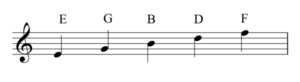
The treble clef is one of the most commonly used clefs today. Example 1 shows the letter names used for the lines of a staff when a treble clef is employed. One mnemonic device that may help you remember this order of letter names is “Every Good Bird Does Fly” (E, G, B, D, F). As seen in Example 1, the treble clef wraps around the G line (the second line from the bottom). For this reason, it is sometimes called the “G clef.”
Example 2 shows the letter names used for the spaces of a staff with a treble clef. Remembering that these letter names spell the word “face” may make identifying these spaces easier.

Example 3 shows an octave treble clef. Notice the small “8” at the bottom of the clef:

An octave treble clef with an “8” at the bottom of the clef indicates that notes should be sung or played an octave lower than written. Music for tenor vocalists, guitarists, and bassists often uses the octave treble clef. A double treble clef also indicates that notes should be sung or played an octave lower than written, but it is much less common. Example 4 shows a double treble clef:

Sometimes music for piccolo or flute will use an octave treble clef with an “8” at the top of the clef. This indicates that notes should be played an octave higher than written. Example 5 shows this clef:

However, piccolo music is always assumed to sound an octave higher than written, regardless of which clef is used–a regular treble clef or an octave treble clef.
Reading Bass Clef
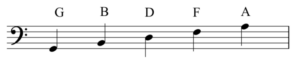
The other most commonly used clef today is the bass clef. Example 6 shows the letter names used for the lines of a staff when a bass clef is employed. A mnemonic device for this order of letter names is “Good Bikes Don’t Fall Apart” (G, B, D, F, A). The bass clef is sometimes called the “F clef”; as seen in Example 6, the dot of the bass clef begins on the F line (the second line from the top).
Example 7 shows the letter names used for the spaces of a staff with a bass clef. The mnemonic device “All Cows Eat Grass” (A, C, E, G) may make identifying these spaces easier.

Reading Alto Clef
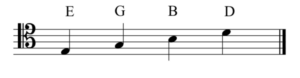
Example 8 shows the letter names used for the lines of the staff with the alto clef, which is less commonly used today. The mnemonic device “Fat Alley Cats Eat Garbage” (F, A, C, E, G) may help you remember this order of letter names. As seen in Example 8, the center of the alto clef is indented around the C line (the middle line). For this reason it is sometimes called a “C clef.”

Example 9 shows the letter names used for the spaces of a staff with an alto clef, which can be remembered with the mnemonic device “Grand Boats Drift Flamboyantly” (G, B, D, F).

Reading Tenor Clef
The tenor clef, another less commonly used clef, is also sometimes called a “C clef,” but the center of the clef is indented around the second line from the top. Example 10 shows the letter names used for the lines of a staff when a tenor clef is employed, which can be remembered with the mnemonic device “Dodges, Fords, and Chevrolets Everywhere” (D, F, A, C, E):

Example 11 shows the letter names used for the spaces of a staff with a tenor clef. The mnemonic device “Elvis’s Guitar Broke Down” (E, G, B, D) may make identifying these spaces easier.
You can practice identifying clefs in the following exercise:
Ledger Lines
When notes are too high or low to be written on a staff, small lines are drawn to extend the staff. These extra lines are called ledger lines. Ledger lines can be used to extend a staff with any clef. Example 13 shows ledger lines above a staff with a treble clef:

Notice that each space and line above the staff gets a letter name with ledger lines, as if the staff were simply continuing upwards. The same is true for ledger lines below a staff, as shown in Example 14:
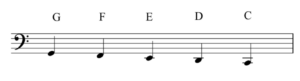
Notice that each space and line below the staff gets a letter name with ledger lines, as if the staff were simply continuing downwards.
Unpitched (Neutral) Clef
A neutral clef is sometimes called an “unpitched clef” or “percussion clef” because it is often used for percussion instruments with indefinite pitch. Example 15 shows a neutral clef on a staff:

In an unpitched clef, the lines and spaces of the staff do not represent letter names, but instead may represent different instruments. Neutral clefs are sometimes used on a single-line staff, as seen in Example 16:

Media Attributions
- Treble Clef Line Letters © Chelsey Hamm is licensed under a CC BY-SA (Attribution ShareAlike) license
- Treble Clef Spaces Letter Names © Chelsey Hamm is licensed under a CC BY-SA (Attribution ShareAlike) license
- Octave Treble Clef 8 Below © Chelsey Hamm is licensed under a CC BY-SA (Attribution ShareAlike) license
- Double Treble Clef © Chelsey Hamm is licensed under a CC BY-SA (Attribution ShareAlike) license
- Octave Treble Clef 8 Above © Chelsey Hamm is licensed under a CC BY-SA (Attribution ShareAlike) license
- Bass Clef Lines Letter Names © Chelsey Hamm is licensed under a CC BY-SA (Attribution ShareAlike) license
- Bass Clef Spaces Letter Names © Chelsey Hamm is licensed under a CC BY-SA (Attribution ShareAlike) license
- Alto Clef Line Letter Names © Chelsey Hamm is licensed under a CC BY-SA (Attribution ShareAlike) license
- Alto Clef Spaces Letter Names © Chelsey Hamm is licensed under a CC BY-SA (Attribution ShareAlike) license
- Tenor Clef Lines Letter Names © Chelsey Hamm is licensed under a CC BY-SA (Attribution ShareAlike) license
- Tenor Clef Spaces Letter Names © Chelsey Hamm is licensed under a CC BY-SA (Attribution ShareAlike) license
- Ledger Lines Above Treble Clef © Chelsey Hamm is licensed under a CC BY-SA (Attribution ShareAlike) license
- Ledger Lines Below Bass Clef © Chelsey Hamm is licensed under a CC BY-SA (Attribution ShareAlike) license
- Neutral Clef © Chelsey Hamm is licensed under a CC BY-SA (Attribution ShareAlike) license
- Neutral Clef Single Line Staff © Chelsey Hamm is licensed under a CC BY-SA (Attribution ShareAlike) license
Related to European or American culture.
A discrete tone with an individual frequency.
A symbol placed on the left side of a staff that indicates which notes are assigned to different lines and spaces.
The span of notes a voice or instrument can produce.
Auditory; related to hearing.
A relationship between pitches that share a letter name but are separated by one or more octaves.
An interval of twelve half steps between two notes with the same letter name. The frequencies of two notes related by octave form a 2:1 ratio. Abbreviated “8ve.”
As a "G" clef, the treble clef designates the second-lowest line of a staff as G₄ by curling around it.
A technique used to aid memorization.
As a "G" clef, the octave treble clef designates the second-lowest line of a staff as G by curling around it. An octave treble clef sounds one octave below or above a treble clef. This is designated with an "8" below or above the treble clef.
As a "G" clef, the double treble clef designates the second-lowest line of a staff as G₃ by curling around it.
As an "F" clef, the bass clef shows which line of the staff is F₃ by surrounding it with two dots.
As a "C" clef, the alto clef shows that C₄ is the middle line of the staff by centering on it.
As a "C" clef, the tenor clef shows that the second-highest line of the staff is C₄ by centering on that line.
Small lines written above or below a staff to extend the staff's range of notes.
A neutral clef is used for percussion instruments of indefinite pitch. The lines and spaces on a staff with a neutral clef indicate different instruments instead of different letter names.