
MUSC&141 Creative Music Fundamentals
Tuplets, Tresillo and Hypermeter
Mark Gotham; Chelsey Hamm; Bryn Hughes; and Melanie Sehman
Key Takeaways
- A triplet is a type of tuplet in which a beat (or subdivision, or multiple beats) in simple meter is divided into three parts. Notate a triplet by writing a 3 above the triplet rhythm.
- A duplet is a tuplet in which a beat (or subdivision) in compound meter is divided into two parts. Notate a duplet by writing a 2 above the duplet rhythm.
- Hypermeter refers to the patterns of accentuation at the metrical level.
Triplets
Typically, a meter is defined by the presence of a consistent beat division: division by two in simple meter, and by three in compound meter. Sometimes composers will use a triple division of the beat in a simple meter, or a duple division of the beat in a compound meter; these rhythms are called tuplets. Triplets are a type of tuplet in which a beat (or subdivision, or multiple beats) in simple meter is divided into three parts. Triplets are sometimes thought of as “borrowed” from compound meter, because the beat in compound meter is usually divided into three parts. A triplet is notated by writing the number 3 on top of the triplet rhythm.
Triplets may occur at both any metric level, as seen in Example 1. In Example 1a, the triplet is at the beat level—this is the most common use of a triplet. Example 1b shows a sixteenth-note triplet, which is equivalent to one eighth note (the division in this time signature). Triplets also may occur across multiple beats, as seen in Example 1c. This triplet (notated with three quarter notes) takes up the space of one half note.
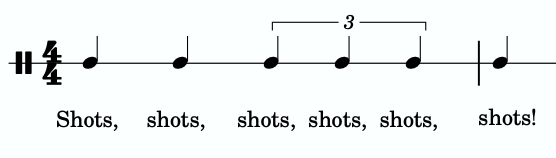
Triplets are extremely common in many different genres of music. One example can be found in LMFAO’s “Shots” (2009). Example 2 show the repeated rhythm from the song’s chorus, which contains a multi-beat triplet:
You can listen to the chorus of “Shots” beginning at 1:18 in Example 3:
Example 3.“Shots” by LMFAO; listen starting at 1:18.
Tresillo
Drawing on its roots in African and Cuban musical traditions, another common rhythmic pattern in pop/rock is to divide a beat (or two beats) into three almost-equal groups: for example, dividing a half note into two dotted eighth notes and an eighth note (3+3+2). This pattern approximates a triplet while still maintaining the simple division of beats by 2, 4, 8, etc., creating an experience of something like a “fake triplet.” The term for this rhythmic pattern is tresillo (Example 4). A tresillo pattern can be heard after the opening cuatro solo of “Despacito” by Luis Fonsi and Daddy Yankee (2016) in the bass and bass drum. The tresillo pattern is extremely common, even in pop music that otherwise doesn’t seem to draw on Afro-Cuban music.
The tresillo is actually more common than “real” triplets in most pop/rock genres, but true triplets do occur, so take care to distinguish between the two. “Cathedrals” by Jump, Little Children (1998) juxtaposes both, and it’s an excellent example for practicing performing and identifying tresillo patterns and real triplets. In Example 5, notice that the violins play quarter-note triplets against simple eighth notes in the guitar, but the guitar begins a tresillo accent pattern after the triplets stop.
While tresillo patterns occur most often in 3+3+2 groupings, 3+2+3 and 2+3+3 are also possible.
The tresillo pattern can be expanded: in Example 5, the 3+3+2 pattern is doubled, resulting in 3+3+3+3+2+2. Nicole Biamonte (2014) refers to this pattern as the double tresillo. In the opening of “Electric Co.” by U2 (1980), the guitar plays subdivisions (sixteenths) grouped 3+3+3+3+2+2, while the kick drum plays straight beats (quarters) under the hi-hat playing straight subdivisions.
Duplets
A duplet is a tuplet in which a beat (or subdivision) in compound meter is divided into two parts. Duplets are notated by writing the number 2 on top of the duplet rhythm, as seen in Example 4.
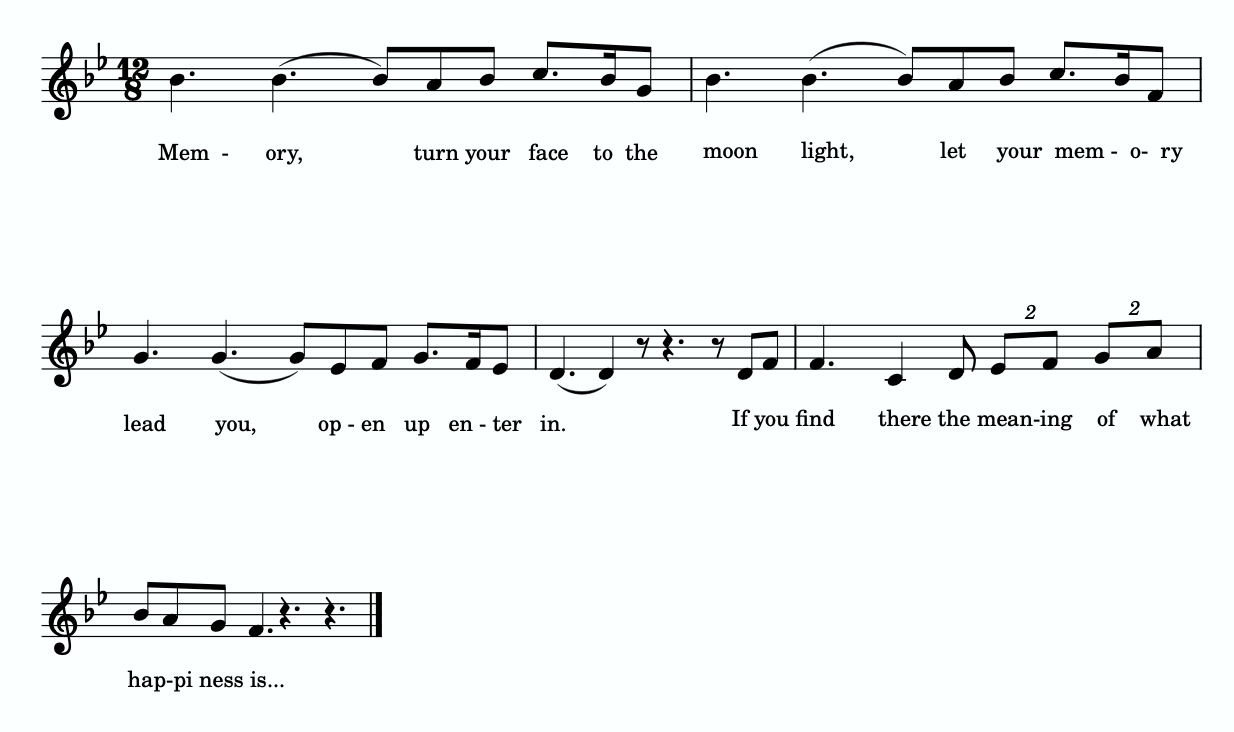
Duplets are also fairly common, though perhaps not as common as triplets. Example 8 shows an excerpt from the reprise of “Memory” from Cats (1980) by Andrew Lloyd Webber, which includes beat-level duplets:
You can listen to this excerpt which includes duplets at the beginning of Example 9:
Example 9.“Memory” by Andrew Lloyd Webber, performed by Elaine Page as Grizabella.
Counting for tuplet rhythms is usually “borrowed” as well. For example, triplets are usually counted 1-la-li, while duplets are usually counted 1-and, 2-and, etc.
A Brief Introduction to Hypermeter
We have seen that beats are either accented or non-accented which was observed in the discussion of conducting patterns in the previous two chapters (see Simple Meter and Time Signatures and Compound Meter and Time Signatures). Hypermeter refers to groups of measures that form patterns of accentuation, especially at faster tempos. In order to label patterns of accentuation across multiple measures, it can be helpful to annotate the score with hypermetrical counts as in Example 10, which shows a reduced excerpt from the “Scherzo” of Ludwig van Beethoven’s Symphony no. 9 (1824). While listening to Example 7, try conducting along to the hypermetrical numbers in a quadruple pattern. By doing this, you will be able to feel (and hear) which measures are more accented (1 and 3) and which are less accented (2 and 4).
This introduction to hypermeter is extremely brief. For more information, you may want to to read Hypermeter by Brian Jarvis, one of the authors of Open Music Theory.
Media Attributions
- Shots Rhythm LMFAO © Chelsey Hamm is licensed under a CC BY-SA (Attribution ShareAlike) license
- Memory Cats Webber © Chelsey Hamm is licensed under a CC BY-SA (Attribution ShareAlike) license
A tuplet that involves dividing a beat in simple meter into three parts.
A rhythm that involves dividing the beat into a different number of subdivisions from that usually implied by the time signature.
A tuplet that involves dividing a beat in compound meter into two parts.
Groupings of measures into different patterns of accentuation akin to meter. A hypermeasure is typically four measures long.
A Latin American guitar-like instrument particularly prevalent in Puerto Rican music.