
Chapter 1: Introduction to the field of Communication Studies
1.4 Communication Competence
Learning Objectives
- Define communication competence.
- Identify and explain characteristics of competent communicators.
- Discuss stages of communication competence.
Defining Communication Competence
Because communication is complex and varies across contexts, defining communication competence is not easy. While some scholars include the terms “effective” and “appropriate” when defining it, not all do. One thing that is common across definitions, however, is the recognition that communication competence is multi-dimensional (i.e., comprised of many skills). For the purposes of our course, we will define communication competence as a set of abilities that facilitate achieve one’s goal while attending to others’ goal(s) within a given context and in a manner that ideally maintains the relationship (Adler et al., 2021; Cooley & Roach, 1984; Litttlejohn & Jabusch, 2009; Vorwerg, 2015). Importantly, this definition recognizes that communication competence does not just focus on getting what one wants, but that it considers the other(s), the context, and relational dynamics while attempting to achieve the overt goal(s) of the interaction
There are several characteristics identified as indicative of component communication by researchers (see Cupach & Spitzberg, 1984, 2011). For the purposes of our course, we will use the characteristics of competent communication identified by Adler & Proctor (2017):
- Wide range of communication skills: To be a competent communication, one needs to have a variety of communication skills to select from in any given situation. Since each communicative event brings with it a constellation of different individuals, contexts, goals, emotions, etcetera, there is no one size fits all with respect to “the” communication skill. Thus, a competent communication will be aware of a variety communication skills .
- Ability to choose most appropriate skill: Beyond having a large variety of communication skills, one needs to be able to assess and choose the most appropriate skill for the given situation. A competent communication will consider things such as goals, individuals, and context when deciding which the communication skill they want to use.
- Skill at performing behaviors: A competent communicator will, once deciding on the skill they want to use, have the ability to actually perform the communicative behavior. There is a difference between knowing which skill would be most effective and being able to put it into practice.
- Cognitive Complexity: Cognitive complexity is the ability to think about a situation from many perspectives, weaving together different (sometimes disparate) pieces of information. For example, when conversing with another person, someone who does not have a high level of this skill will perceive the content at face value. Someone with a high level of cognitive complexity will be able to perceive the content beyond face value. Does this person have an ulterior motive? What is the intent of their message? What else could this person mean besides the words they actually say? Those are questions someone who is cognitively complex would be pondering during an interaction.
- Empathetic– Competent communicators are empathetic, meaning they can feel and experience another’s situation, almost as they do. For example, when a friend calls to say they had a fight with their romantic partner, an empathetic response might be “Wow, that must be really difficult for you.” An unempathetic response might be “Oh. So it sounds like you’ll be breaking up with them then.” Note that empathy generally requires an acknowledgement of emotion.
- Self Monitoring: Self monitoring refers to the skills of paying attention to one’s communicative behaviors and using these observations to shape the interactions within the moment. A high self-monitor is aware of their behaviors and adjusts accordingly in different contexts. A low self-monitor will not adjust their behaviors to different contexts. This becomes problematic when the goals of the interaction are not being achieved, yet one continues to do the same communicative behaviors hoping for a different result.
One final characteristic of competent communicators that was not identified by Adler and Proctor, but that we will use in our class, is that of ethical communication.
- Ethical: Competent communicator are ethical, meaning they do not try to purposely deceive, offend, or trick others. Ethical communicator also use their own words and cite sources if necessary.
All of the characteristics of communication competence lead one to becoming a mindful while communicating with others. This means we actively and fluidly processes information, are sensitive to communication contexts and multiple perspectives, and are able to adapt to novel communication situations (Burgoon, Berger, & Waldron, 2000). Becoming a competent communication has many benefits, including in the simplest of communication interactions—a conversation. Being mindful during conversations can help build and maintain positive relationships, be key to accomplishing goals in our personal and professional lives or serve to simply learn something that we can apply in many ways. In a Tedx Talks (2015) presentation, Celeste Headlee, an award-winning interviewer, proposes that there are 10 rules to having a good conversation:
- Stop multitasking.
- Assume you have something to learn.
- Use open-ended questions.
- Go with the flow. Allow your own thoughts to enter, then let them go. Remain focused on the speaker’s messages.
- If you don’t know, say you don’t know.
- Don’t equate your experience with theirs. Let the moment be about them.
- Try not to repeat yourself. It’s boring and condescending.
- Don’t get bogged down in the details. Focus on learning about the person, and them learning about you.
- Listen. When we are speaking, we are not learning.
- Be brief—short enough to retain interest, long enough to cover the subject.
Notice that each “rule” Headlee lists can align with one or more of the characteristics of competent communicators (e.g., Rule 5, “if you dont know, say you don’t know” would fall under the competent communicator characteristic of ethical). As communication scholars, we know that there truly isn’t a set of “rules” for any communicative act (e.g., conversation, presentation), but Headlee provides an interesting list of skills that may be useful while in conversations.
Stages in Developing Competence
Knowing the skills of competence is an important first step toward developing competence. Everyone reading this book already has some experience with and knowledge about communication. After all, you’ve spent many years explicitly and implicitly learning to communicate. For example, we are explicitly taught the verbal codes we use to communicate. On the other hand, although there are numerous rules and norms associated with nonverbal communication, we rarely receive explicit instruction on how to do it. Instead, we learn by observing others and through trial and error with our own nonverbal communication. Competence obviously involves verbal and nonverbal elements, but it also applies to many situations and contexts. Communication competence is needed in order to understand communication ethics, to develop cultural awareness, to use computer-mediated communication, and to think critically. Competence involves knowledge, motivation, and skills. It’s not enough to know what good communication consists of; you must also have the motivation to reflect on and better your communication and the skills needed to do so.
Since communication competence is a dynamic and evolving process, we will continuously have competencies we are skilled in and areas where we can improve. The development of communication competence occurs over time and through a series of four stages (Hargie, 2011).
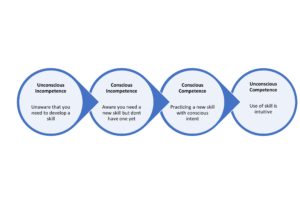
Stage 1: Unconscious Incompetence. Before you have built up a rich cognitive knowledge base of communication concepts and practiced and reflected on skills in a particular area, you may exhibit unconscious incompetence, which means you are not even aware that you are communicating in an incompetent manner.
Stage 2: Conscious Incompetence. Once you learn more about communication and have a vocabulary to identify concepts, you may find yourself exhibiting conscious incompetence. This is where you know what you should be doing, and you realize that you’re not doing it as well as you could.
Stage 3: Conscious Competence. As your skills increase you may advance to conscious competence, meaning that you know you are communicating well in the moment, which will add to your bank of experiences to draw from in future interactions.
Stage 4: Unconscious Competence. When you reach the stage of unconscious competence, you just communicate successfully without having to think about being competent. Just because you reach the stage of unconscious competence in one area or with one person does not mean you will always stay there. We are faced with new communication encounters regularly, and although we may be able to draw on the communication skills we have learned about and developed, a new situation or encounter may affect our level of competence.
In some introductory communication classes students think that Communication Studies professors must have high levels of communication competence. While knowing concepts, definitions and research within the field is a start, it doesn’t mean professor always put this information to good use. We are all imperfect and fallible, and if we expect to be perfect communicators after studying this, then we’re setting ourselves up for failure. However, what we can all make mental notes and reflect on how our interactions with other are going.
Key Takeaways
- Communication competence refers to a set of abilities that facilitate achieve one’s goal while attending to the goal(s) of others, within a given context, and in a manner that ideally maintains the relationship
- Competent communication is characterized by the following: wide range of skills, ability to choose skill, ability to perform skills, cognitive complexity, empathy, self-monitoring and ethics.
- Stages of communication competence include unconscious incompetence, conscious incompetence, conscious competence, and unconscious competence.
Attribution
Unless otherwise indicated, material on this page has been reproduced or adapted from the following resource: Introduction to Communications Copyright © 2023 by NorQuest College is licensed under a Creative Commons Attribution-NonCommercial-ShareAlike 4.0 International License, except where otherwise noted.
References
Adler, R. B. , & Proctor, R. F.,(2017). Looking out looking in. Fifteenth edition. Boston, MA., Cengage Learning.
Adler, R. B., Rolls, J. A., & Proctor II, R. F. (2021). LOOK: Looking out, looking in (4th ed.). Cengage Learning.
Bergoon, J. K., Berger, C. R., & Waldron, V. R. (2002). Mindfulness and interpersonal communication. Journal of Social Issues, 56(1), 105–127. https://doi.org/10.1111/0022-4537.00154
Cooley, R. E., & Roach, D. (1984). A conceptual framework. In R. Bostrom (Ed.), Competence in communication: A multidisciplinary approach (p. 25). Sage.
Hargie, O. (2011). Communicating effectively: The skills approach. In Skilled interpersonal communication: Research, theory and practice (pp. 1-12). Routledge.
Littlejohn, S. W., & Jabusch, D. M. (1982). Communication competence: Model and application. Journal of Applied Communication Research, 10(1), 29–37. https://doi.org/10.1080/00909888209365210
Morreale, S., Rubin, R. B., & Jones, E. (Eds.). (1998). Speaking and listening competencies for college students. National Communication Association (NCA). https://www.natcom.org/sites/default/files/pages/Assessment_Resources_Speaking_and_Listening_Competencies_for_College_Students.pdf
TEDx Talks. (2015, May 7). How to have a good conversation | Celeste Headlee | TEDxCreativeCoast [Video]. YouTube. https://youtu.be/H6n3iNh4XLI
Vorwerg, C. (2015). Communicative competence: Linguistic aspects. In International Encyclopedia of the Social & Behavioral Sciences (2nd ed.) https://doi.org/10.1016/B978-0-08-097086-8.53042-6
